The Thread That Didn't Break: My Journey So Far
When I was six, I wanted to make a video game.
Not play one. Make one. I'd finish a level and the interesting question wasn't what came next, it was how the thing worked, and whether I could build one of my own. I didn't have the words for it then, but that pull never left. It's what has me writing this, decades later, from the other side of a career I never planned.
I did chase the games. I taught myself HTML basics before I really understood what a website was. Around ten I tried to learn C++, bought in completely, and got nowhere, because wanting to build something and knowing how to make it compile are very different problems. In high school I got further: Turing, then Visual Basic, and a clumsy prototype of the original GTA's top-down movement, complete with pedestrians that had just enough logic to walk into walls. It was bad. I loved it.
Humber, and the First Wall
So I did the obvious thing and enrolled in Humber's three-year game programming diploma. And I almost failed the first semester.
The strategies that carried me through high school (show up, coast on aptitude, cram the night before) fell apart against college-level work. For the first time, being naturally okay at something wasn't enough. I had two options: decide I wasn't cut out for it, or change how I worked. I changed how I worked. I leaned in harder than I ever had, clawed my way back, and by the end I wasn't just passing, I was ahead.
Remember that pattern. It comes back.
Humber is also where I went deep. Java, C#, C++, OpenGL, socket networking. I wrote my own model loader for OBJ and FBX files, animations and all, instead of pulling in a library, because I wanted to understand the whole thing. I built a game engine with a particle system. I shipped an RPG on Android. And somewhere in the middle of all of it, I realized something I hadn't gone in looking for: I didn't love games. I loved building things. Games were just the first shape it took.
The Second Wall: No One Was Hiring Game Developers
Then I graduated into a hard fact. Stable, paying jobs in game development are rare, and the few that exist are brutal to land. I'd spent three years training for a career that didn't have room for me.
If the north star was games, that's where the story ends. It wasn't. It was building. So I went where the building was.
I joined Clearbridge Mobile, a mobile app studio, and worked across Android, iOS, and BlackBerry 10 on apps for Disney, NBC Sports, Telemundo, and Tim Hortons, including the first NFC payment in Canada. Around the same time I went back to Humber, this time at the front of the room, teaching intro to Java and databases for a semester. The student came back as the teacher, and I learned how little you actually understand something until you have to explain it to a room of people who don't.
Building in New Materials
From there the work kept changing shape, and I kept following it.
At Digiflare I went deep on Android and TV, porting a Hearst FireTV app into twenty-six different branded flavours and shipping other FireTV apps alongside it. ecobee was where I moved a hybrid mobile app fully native and sank real time into the two-thumb thermostat control and its animation, the kind of detail nobody notices unless it's wrong. Then Rogers, where I became the Android lead and rebuilt the myRogers app from the ground up. We launched on time, with low bugs, which if you've shipped a large consumer app you know is not a given. After that I re-architected myFido to share a foundation with it.
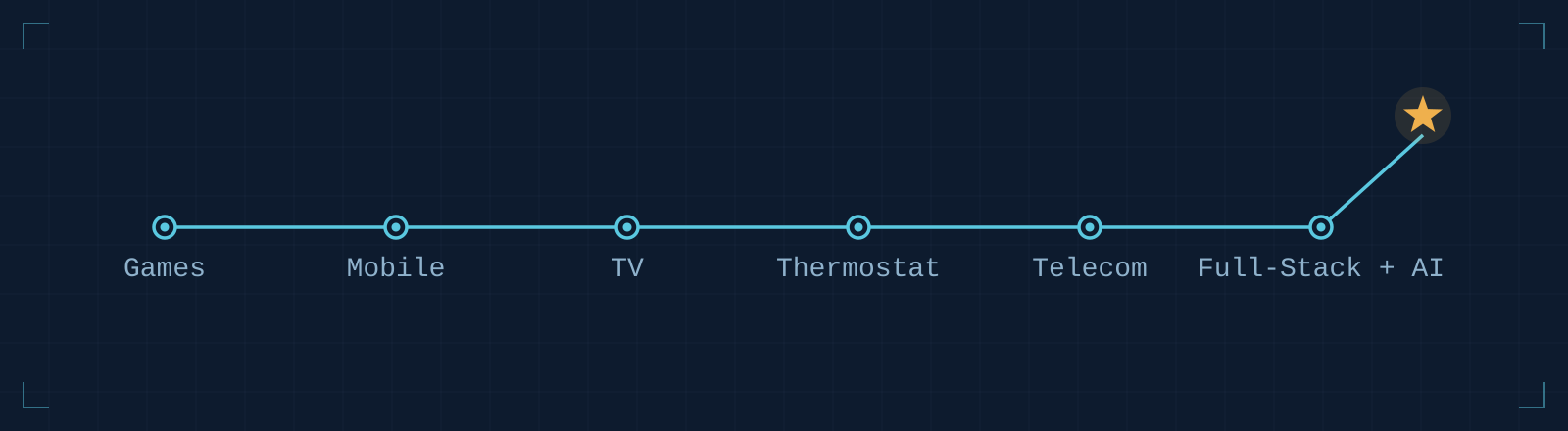
A game engine, mobile apps, TV apps, a thermostat, a telecom app. Different material every time, the same instinct underneath: build the whole thing, and go one layer deeper than you strictly have to. The kid who wrote his own model loader instead of grabbing one off the shelf is the same person, just with better tools.
RTI, and the Whole Stack
The most recent turn was the biggest. I joined RTI to get out of the mobile lane and into web and backend, and it became the widest stretch of my career. Infrastructure, databases, backend, frontend, and lately AI. For the first time I could see a system end to end and work at every layer of it. The generalist I'd been quietly becoming since Humber finally had the whole board to play on.
The Third Wall Is Happening Now
Which brings me to the wall I'm standing at today.
AI is changing what it means to build software, and it's moving fast enough that I can feel the ground shift under me. It's the same feeling as that first semester at Humber: the way I've always worked is suddenly not quite enough, and I have a choice about what to do next. I know this one by now. You don't wait for it to settle. You lean in, you get your hands into it, you get out ahead of it.
This blog is part of that. Writing these posts is me doing the thing in public, working out how I build now that there's a machine in the loop with me.
A North Star and the Stubbornness to Follow It
Two things have carried me the whole way, and they're the only advice I'd actually stand behind.
The first is a north star. Mine has been the same since I was six: I build things. Every time the path forced a turn, games to mobile, mobile to full-stack, and now whatever AI makes of all of it, the star didn't move. Only the material did. Knowing that is what kept every turn from feeling like a loss. It was just the next place to build.
The second is perseverance, which is a kinder word than what it actually is: leaning in when the old way stops working, and staying there until you're ahead again. I've done it at every wall. I'm doing it right now.
And there's a strange symmetry to where it's landed. At six, I wanted to build a whole world by myself. I had to specialize, join teams, and learn to build one layer at a time to make a living doing it. But full-stack range plus AI means one person can build a whole thing again, end to end. All these years later, I've circled back to exactly what I wanted in the first place, carrying everything I picked up on the way around.